Business Travel Accommodation in Sydney: How to Choose
Business Travel Accommodation in Sydney: How to Choose
The best business travel accommodation is the one that lets you work well and sleep well for the whole trip. For one or two nights, a hotel near your meeting is usually enough. Once a trip stretches past about a week, a furnished home with a real kitchen, a proper desk and a separate place to sleep tends to win on comfort, productivity and total cost. This guide covers how to decide, what to check before you book, and what that looks like in central Sydney.
TL;DR
- For stays of a few nights, a CBD hotel is simple. For a week or more, a furnished home usually gives you more space, a kitchen and better value over the whole stay.
- 44% of business travellers now prefer apartment-style stays over traditional hotels, mainly for space and kitchen access.
- Check Wi-Fi, a workable desk, cancellation terms, check-in method and walking distance to transport before you pay.
- Compare the total cost of the stay, including meals, laundry and lost working time, not just the nightly rate.
- Our Surry Hills terrace is a short walk from Central Station and the CBD, and you can book it directly.
Table of Contents
- Who needs business travel accommodation, and for how long
- Hotel or furnished home: an honest comparison
- What to check before you book
- Counting the real cost of a stay
- Why length of stay changes everything
- A good week in a furnished Sydney home
- Our perspective: what business guests tell us they need
- Our Surry Hills terrace for business stays
- Why Surry Hills works for work trips
- Booking for a team or a company
- Questions to ask any host before you pay
- FAQ
- Sources
Who needs business travel accommodation, and for how long
Business travel is not one kind of trip. A sales rep flying in for a Tuesday meeting has different needs from a consultant on a six-week project, an engineer commissioning equipment, or a family relocating for a new role while they look for a lease.
It helps to sort your trip by length, because length changes what matters most:
| Length of stay | What matters most | Typical best fit |
|---|---|---|
| 1 to 3 nights | Location, quick check-in, quiet room | Hotel near the meeting |
| 4 to 14 nights | Desk, Wi-Fi, laundry, somewhere to cook | Hotel suite or furnished home |
| 2 weeks to 3 months | Kitchen, separate living area, laundry, flexible terms | Furnished home |
| Relocation, 1 month or more | Monthly terms, space for family, reliable support | Furnished home |
The split is not about luxury. Industry analysis suggests that for stays beyond roughly a week, guests care less about daily room service and more about residential functionality: cooking basic meals, separating work from sleep, and a stable connection for video calls.
Hotel or furnished home: an honest comparison
Hotels do some things very well. A front desk, a lobby for informal meetings and a gym on site are real advantages on a short trip. A furnished home does other things better. Here is how they compare on the criteria that matter to a working traveller.
| Criterion | Hotel | Furnished home |
|---|---|---|
| Space | One room, often compact | Separate bedrooms and living area |
| Kitchen | Minibar at best | Full kitchen for breakfast and simple dinners |
| Laundry | Paid service, next day | In-home facilities |
| Working setup | Small desk, shared lobby | Table or desk in a living area, quiet at night |
| Check-in | Front desk hours | Self check-in at any hour |
| Services | Daily housekeeping, concierge | Professional cleaning, guest support by message |
| Group travel | Several rooms, several bills | One home for a small team or family |
The Corporate Traveller travel manager survey is worth knowing about if you set or follow a company travel policy. It found that 72% of travellers ranked complimentary breakfast as the most attractive perk, 58% wanted free cancellation up to 24 hours before arrival, and 50% treated free, fast Wi-Fi as a baseline. A kitchen answers the breakfast question on your own terms, and the other two come down to the property's published terms, which you can check before booking.
What to check before you book
Photos sell every property. These checks tell you whether it will actually work for a working week.
Internet you can run meetings on
Ask for the plan speed, not just "high-speed Wi-Fi". The AltoVita analysis puts a comfortable range for stable video conferencing at 150 to 500 Mbps for extended stays. If your week is calls and shared documents, message the host and ask. A good host answers quickly and specifically.
A place to work that is not the bed
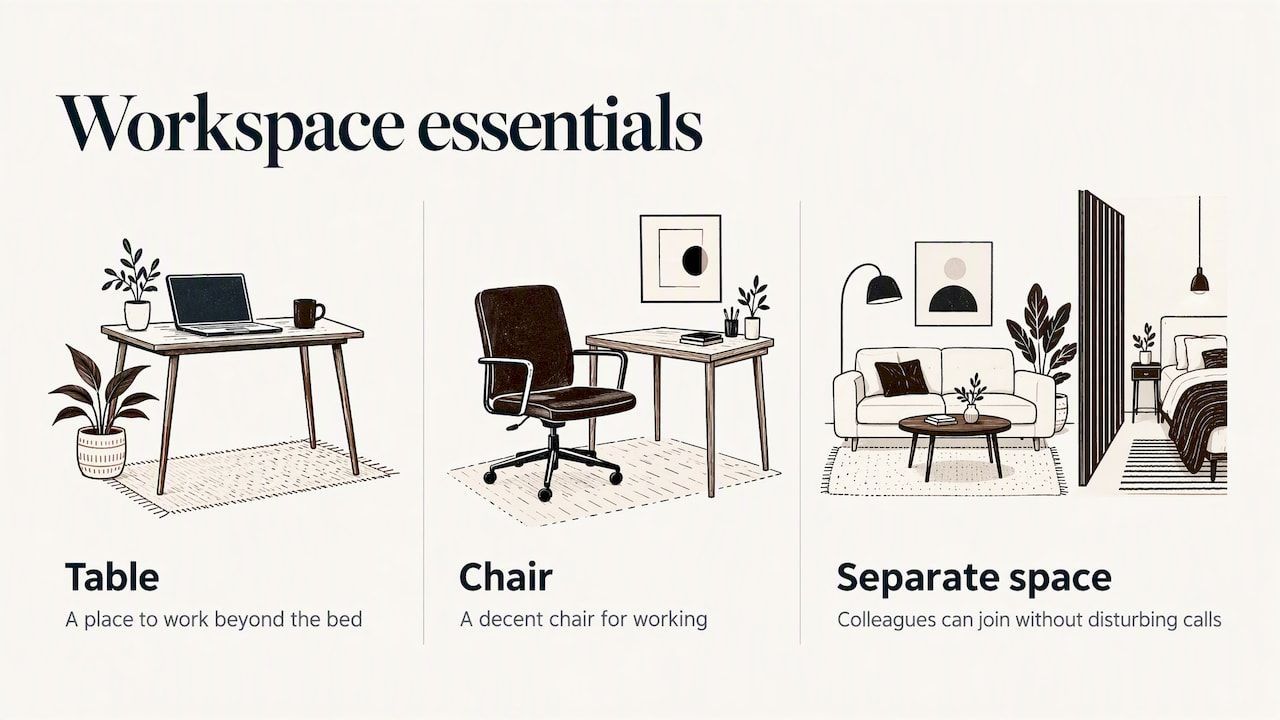
Look for a table, a decent chair and a living area separate from where you sleep. After three days of working from a hotel bed, most people feel the difference. Separate living space also lets a colleague or partner be in the property without disturbing a call.
Cancellation and no-show terms
Plans change on business trips: meetings shift, projects slip. The terms should be stated clearly before you pay. Tourism guidance from VisitBritain recommends that accommodation businesses have a cancellation procedure and make it explicit before a booking is finalised. That guidance is British, but the principle is sound anywhere: if you cannot find the policy before paying, ask. Ours is set out on our booking information page.
Check-in that fits a flight schedule
Flights land late and meetings run over. Self check-in means you are not racing a front desk that closes, and you can arrive at a time that suits your day.
Walking distance to transport
In Sydney, a short walk to a train station can save more time than a taxi to a hotel with a prestige address. Check the walk on a map, not the "minutes to the CBD" claim on a listing.
Counting the real cost of a stay
The nightly rate is only part of the bill. Travel managers are increasingly asked to look at the total cost of stay, which includes incidentals such as eating out, and the effect on a traveller who has no room to live in for weeks.
Here is a simple way to work it out for your own trip:
- Add up the accommodation cost for every night, including cleaning or booking fees.
- Estimate meals. If you would normally buy breakfast and one dinner each day, a kitchen lets you replace some of those.
- Add laundry. A week of shirts at a hotel laundry service adds up.
- Add transport between the accommodation and where you work.
- Add the cost of changing plans: what happens to the money if the trip moves?
If you are an employee, it also helps to know the tax benchmark. The ATO sets "reasonable amounts" for overnight travel allowances each year. One accounting guide reports that for 2026-27 the accommodation figure for Sydney is $230 for employees on the lower income band, under determination TD 2026/4. Your employer's own travel policy may differ, so check it, and ask your accountant if you are claiming costs yourself.
Why length of stay changes everything
Multi-week assignments are where a furnished home earns its place. Industry commentary on hybrid hospitality describes how the line between hotel and home has blurred for the extended-stay business guest, such as consultants on long assignments and people relocating.
There is a broader pattern behind this. Hybrid work has blurred business and leisure travel, so people want a space that works as an office by day and a home by night, according to the AltoVita trends analysis. The same analysis notes that standard hotel rooms are increasingly hard to live in beyond a few days.
The serviced and furnished sector is also growing because of this demand. The 2025 Global Serviced Apartment Industry Report reported growing demand driven by corporate relocations, with a global average daily rate of £145, though that varies a lot by city.
A good week in a furnished Sydney home
Here is what a working week can look like in a self-contained home near the CBD.
- Monday: You arrive after a late flight and let yourself in with a self check-in code. No queue, no waiting for a key.
- Tuesday to Thursday: Breakfast in your own kitchen, a call at the dining table on the Wi-Fi, then a walk to Central Station for a meeting in the city.
- Wednesday evening: You cook a simple dinner or walk to a nearby café or restaurant. The laundry runs while you answer emails.
- Friday: You pack at your own pace and stay flexible on timing.
None of this is glamorous. It is the small ordinary things that make a long trip tolerable. Research summarised by Corporate Traveller also points to proximity to cafés, parks and walking routes as something savvy business travellers look for, because switching off after work reduces burnout on longer assignments.
Our perspective: what business guests tell us they need
We run furnished homes in central Sydney, and we built our approach around the way work trips really go. Business guests rarely ask for more luxury. They ask for the basics done reliably: fast Wi-Fi, air conditioning that works, a clean place, a kitchen, laundry, and a host who replies quickly when something comes up.
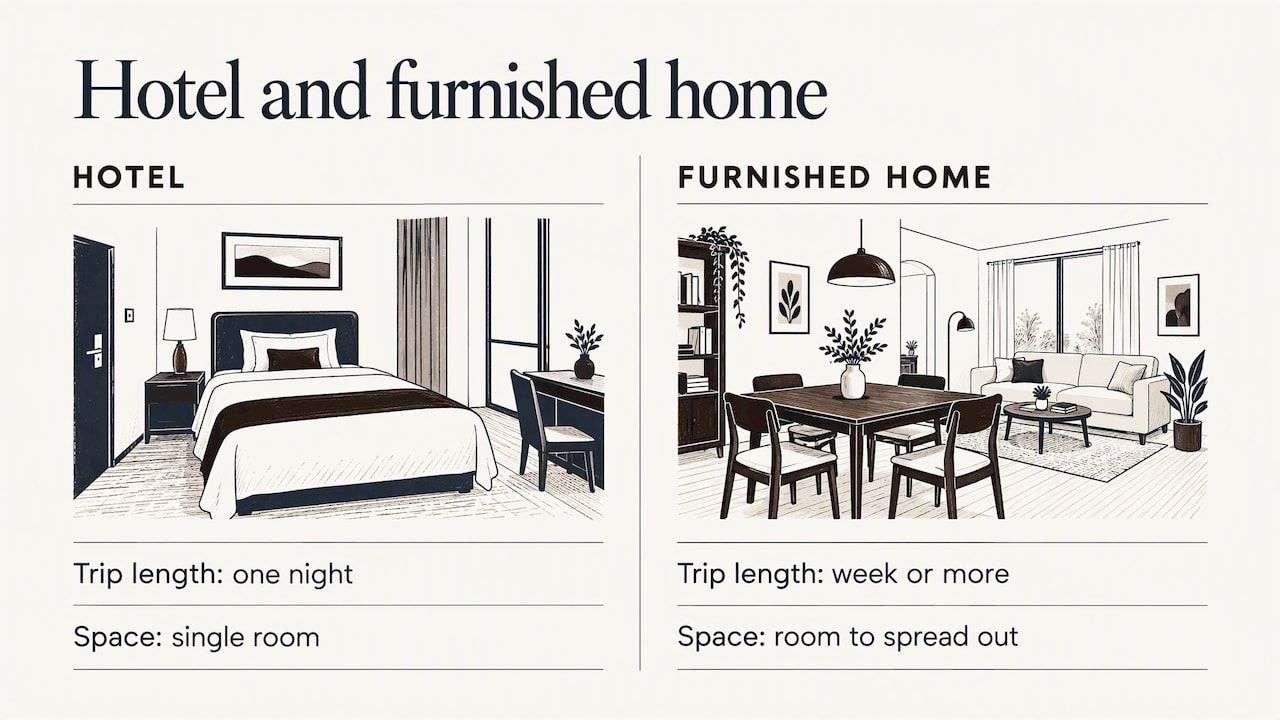
We think the hotel is the right answer for a one-night trip, and we say so. Where we are strongest is the stay of a week or more, a trip with a partner or family, or a small team that would otherwise book several rooms. A whole home gives those guests space to spread out, which a single room cannot. We also keep booking direct through our website, so our rates are competitive and you deal with us rather than a middleman.
Two things we ask every business traveller to do, whoever they book with: read the cancellation terms before paying, and confirm the Wi-Fi supports your work. If a host cannot answer both quickly, take that as information.
— User
Our Surry Hills terrace for business stays
Our featured property is a two-bedroom terrace at 112 Reservoir Street, Surry Hills. It is within walking distance of Central Station, the Sydney CBD and Chinatown, and close to some of the city's best cafés and restaurants.
It has comfortable bedrooms, a fully equipped kitchen, air conditioning, high-speed Wi-Fi, smart TV entertainment, laundry facilities, self check-in and professionally cleaned living spaces. It suits business travellers, couples, families and small groups, and it works for stays of several weeks or months as well as shorter trips.
You can see the property on its Sydney furnished accommodation page, browse everything we offer under short-term accommodation, and read what previous guests said in our guest reviews. For current rates and availability, start from our homes in Sydney page.
Why Surry Hills works for work trips
Surry Hills sits right next to the CBD, so the commute is short, and it has the café and dining scene that the business-and-leisure crowd looks for. Central Station is the practical advantage: it connects you to the city centre and the wider rail network, which matters when meetings are spread across Sydney.
That location also helps with the "switching off" part of a trip. After a day of meetings, you can walk to dinner rather than order room service, then walk home to a quiet street instead of a hotel corridor.
Booking for a team or a company
If you book for others, a few extra points apply.
- Put the terms in writing. Cancellation, no-show and changes should be clear before anyone pays, so your finance team can see the policy.
- Match the property to the group. Two colleagues who need privacy are well served by a two-bedroom home. Four people who need to work separately are not.
- Keep records tidy. Companies increasingly worry about expense errors and fraud. Booking.com's business guide notes that many fraudulent expenses stem from weaknesses in travel expense policy, so a clear booking confirmation and receipt for each stay is good practice.
- Plan for flexibility. Projects extend. Ask whether you can add nights, and what the process is, before you commit.
Questions to ask any host before you pay
Use this short list with any provider, including us:
- What is the Wi-Fi plan speed, and can I do video calls reliably?
- Is there a table or desk where I can work comfortably?
- What are the cancellation and change terms?
- How does check-in work if I arrive late?
- What is the walk to the nearest station?
- Is laundry in the property?
- How quickly do you reply to messages during my stay?
Clear, fast answers to these seven questions tell you most of what you need to know.
FAQ
Is a furnished apartment or a hotel better for a business trip?
For one or two nights, a hotel is usually simpler. For a week or longer, a furnished home generally gives you more space, a kitchen and laundry, which can lower your total cost. A Corporate Traveller survey found 44% of business travellers prefer apartment-style accommodation.
What should I look for in business trip accommodation?
Prioritise reliable Wi-Fi, a proper place to work, a clear cancellation policy, easy check-in and a short walk to transport. For stays beyond a week, add a kitchen and laundry. Ask the host to confirm each point in writing before you pay.
Can I book a furnished home for a few weeks or a month?
Yes. We offer furnished homes in Sydney for short-term, medium-term and monthly stays. Check availability and terms on our booking information page, or contact us about your dates.
Is a Sydney terrace suitable for a small team?
It can be. Our Surry Hills terrace has two bedrooms, a full kitchen and a living area, so it suits two colleagues or a small group who want to share one place. For larger teams, ask us about your numbers before booking.
Sources
- Apartment hotels and free breakfast top business travel wish list, Corporate Traveller
- 10 Corporate Accommodation Trends to Watch in 2025, AltoVita
- 2025 GSAIR reveals £145 ADR and rising corporate relocation, Serviced Apartment News
- The State of Hybrid Hospitality, HotelTechUpdate
- Handling Customer Cancellation and No Shows, VisitBritain
- ATO Overnight Travel Allowance rules and rates, Nanak Accountants
- Preventing Business Travel Expense Fraud, Booking.com for Business
Recommended
Recent Posts