Family-Friendly Accommodation in Sydney: What to Check Before You Book
Family-Friendly Accommodation in Sydney: What to Check Before You Book
Family-friendly accommodation is a place where the whole family can sleep, eat, wash clothes and recover without fighting the building. That usually means separate sleeping spaces, a proper kitchen, laundry, reliable cooling and a location where you can walk or take a train rather than organise a car for every outing. A kids' menu and a toy basket at reception help, but they don't decide the matter. This guide shows you how to check those things in Sydney before you pay, and where a furnished terrace fits.
TL;DR
- "Family-friendly" is a marketing label, not a standard. Check the layout, laundry, kitchen, cooling and safety features yourself.
- Two bedrooms and a kitchen often cost less to live in than two connected hotel rooms, and they make nap times and early bedtimes easier.
- Book early for NSW school holidays. The summer break 2026-27 starts on Friday 18 December 2026 for the eastern division.
- Choose a base near Central Station and you can reach most of Sydney by train, light rail or on foot.
- Our two-bedroom terrace in Surry Hills is built for families, couples travelling with friends and stays of several weeks.
Table of Contents
- Why a hotel room often isn't the family answer
- The checklist: what family-friendly should actually mean
- Location: why Central Station matters with kids
- When to book: Sydney school holidays
- Short stay or long stay: how the format changes the choice
- Perspective: how we think about family stays
- Our Surry Hills terrace for families
- Accessibility and multi-generational groups
- Questions to ask any host before you pay
- A sample day when the base works
- Planning around events and the neighbourhood
- FAQ
- Sources
Why a hotel room often isn't the family answer
A standard hotel room puts everyone in one space. Once the youngest is asleep at 7.30 pm, the adults are sitting in the dark or in the bathroom. Add a travel cot, a bag of snacks and wet swimmers, and the room feels small by day two.
Families tend to want three things a hotel struggles to give:
- A door between the adults and the sleeping children.
- A kitchen , so breakfast, school-style lunches and a late bottle don't depend on room service hours or a café queue.
- A washing machine , because children go through clothes quickly.
Self-contained accommodation covers all three. Hotels with family suites can too, so the question is what is actually in the room, not what the category is called.
The checklist: what family-friendly should actually mean
Industry guides on finding a family-friendly apartment point out that many units are designed for young professionals or empty nesters, and that families should look at layout, storage and quiet space rather than the headline photo. Use the list below as a filter, and ask the host about anything the listing doesn't show.
Sleeping arrangements
- Count beds, not "sleeps" numbers. A listing that sleeps six on paper may rely on a sofa bed in the living room.
- Ask where a portable cot would fit. Spare corners, a wide hallway or an L-shaped living area can give a baby a darker, quieter spot than an open-plan room. The same guide notes that these flexible spaces often work well for nap times.
- Look at the distance between bedrooms. Parents of a toddler and a teenager want some separation. Parents of a baby may want the opposite.
Kitchen and laundry
- A full kitchen with a fridge, oven, cooktop and the basic cookware you need for a family meal.
- Laundry on site, or at least in the building. Parents who have travelled with toddlers often rate this above fancy furniture.
- A dishwasher or a sink big enough to wash bottles and plates without stacking them on the bench.
Cooling in a Sydney summer
Sydney summers can be hot and humid, and babies and older relatives feel it first. The WHO's heatwave guidance says to keep your home cool and to protect infants and children, and it suggests keeping indoor rooms below 32°C during the day and 24°C at night. It also says air conditioning set to 27°C combined with an electric fan can make a room feel about 4°C cooler.
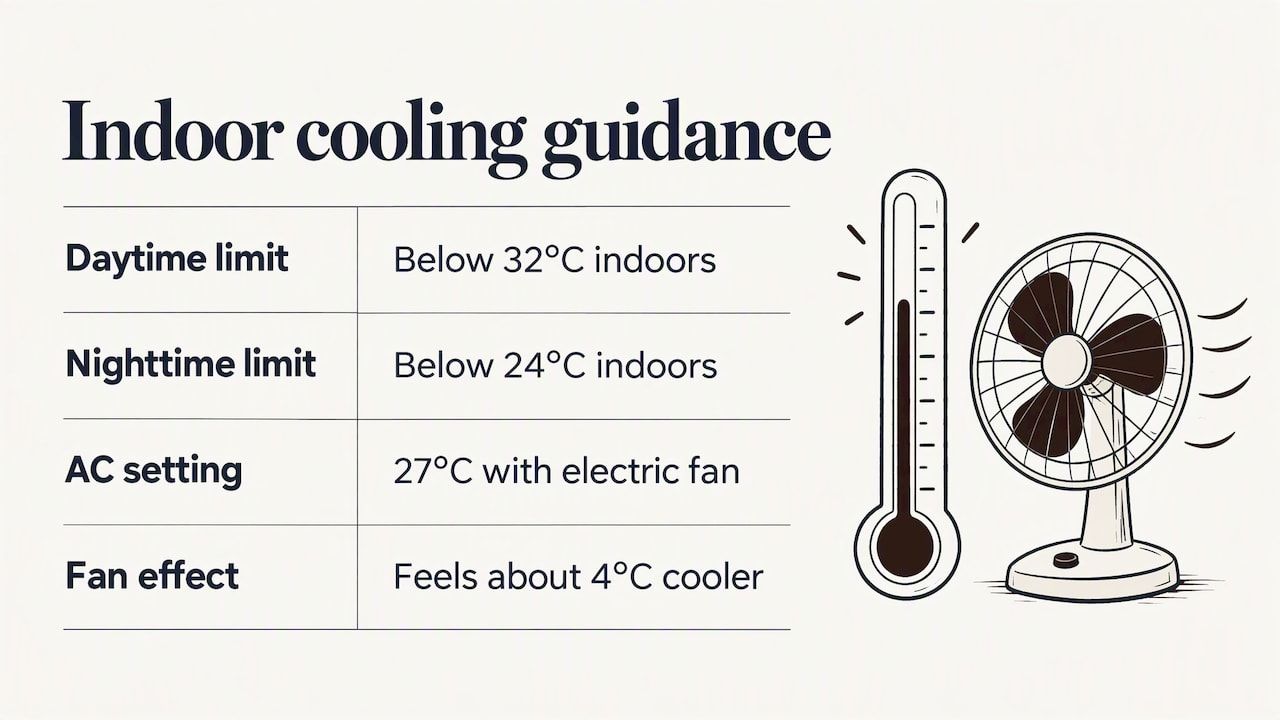
So confirm there is air conditioning in the bedrooms or living space, not just a ceiling fan. If your trip falls between December and February, treat it as a must-have.
Safety features worth asking about
Housing safety is mostly about what you can't see in a photo. Before you book, ask the host about:
- Balcony or window access, and whether locks or restrictors are fitted.
- Hot water temperature. The WHO's burn prevention material lists lowering hot water heater temperatures among the strategies shown to reduce burns in high-income countries.
- Stairs. Many Sydney terraces are multi-level, so ask about gates or how steep the staircase is.
- Any pool or spa. In NSW, pools and portable pools holding more than 30 cm of water need a child-resistant barrier that complies with Australian Standard AS1926. If a property has one, ask to see its compliance details.
A host who answers these questions quickly and specifically is a good sign. Vague answers are not.
Communication and house rules
With a family, small problems pile up: a missing high chair, a late arrival after a long flight, a question about bin day. Look for a host who publishes house rules and emergency information up front and who replies to messages the same day. UN Tourism's guidance for tourism businesses notes that surfacing clear information in booking details helps guests plan and reduces complaints. Reading previous guests' reviews will tell you the rest.
Location: why Central Station matters with kids
A family trip lives or dies on how easy it is to get from the door to the day's activity. In Sydney, the most useful base is one near Central Station, because the main train network, the light rail and many bus routes meet there. From the Surry Hills end of town you can walk to the CBD, Chinatown and Haymarket, and reach the harbour, Darling Harbour and the city's museums without a car.
That has practical benefits:
- No parking cost or stress. Inner-city parking is expensive and hard to find, and car seats are a hassle if you only need them twice.
- Short trips fit nap schedules. A 15-minute walk home from a park is easier than a 40-minute drive.
- Food is close. Surry Hills and the surrounding streets have cafés and restaurants for every mood, so a tired family can eat within minutes.
If you are staying with visiting relatives or travelling in a multi-generational group, walkability matters even more. Tourism Australia's China market insights show that visitors coming to see friends and relatives stay an average of 54 days, which makes them Australia's second longest-staying cohort. Long stays reward a self-contained home with a kitchen, laundry and a bit of room for everyone.
When to book: Sydney school holidays
Families are the main driver of peak dates, so check the calendar before choosing. The NSW Government's school holiday dates list the 2026 breaks as:
| Break | Dates (eastern and western divisions) |
|---|---|
| Spring holidays 2026 | Monday 28 September to Friday 9 October 2026 |
| Summer holidays 2026-27, eastern division | Friday 18 December 2026 to Wednesday 27 January 2027 |
| Summer holidays 2026-27, western division | Friday 18 December 2026 to Wednesday 3 February 2027 |
The summer break overlaps Christmas, New Year and the heat, so the best-placed homes fill early. Interstate families should also check their own state's term dates, because they differ from NSW. If you can travel a week before or after a break begins, you will usually find more choice.
Short stay or long stay: how the format changes the choice
A weekend or a week. You want a place that is easy to enter and easy to leave. Self check-in matters here, because flights with children rarely land on schedule.
Two to four weeks. Now the kitchen and laundry matter more than the view. You will cook most breakfasts and some dinners, and you will do several loads of washing.
Months. Families relocating to Sydney, or waiting on a lease, need a furnished base while they find schools, a suburb and a home. Flexible stay lengths and a host who handles cleaning and maintenance take pressure off an already stressful move.
Perspective: how we think about family stays
We run Harbour Stay Collective as a Sydney accommodation provider for short, medium and extended stays, and families are one of the groups we see most often. Here is what we think matters, and what we have built our offer around.
First, space beats styling. A family wants a place to put things down, bedrooms that can be closed, and living areas where the adults can sit while the children sleep. That is why our featured property is a two-bedroom terrace rather than a single hotel-style room.
Second, the everyday basics decide the trip. A fully equipped kitchen, laundry facilities, air conditioning and fast Wi-Fi are not luxuries when you are managing meals, clothes and a school-aged child's tablet on a wet afternoon. We list them clearly so you can see them before you book.
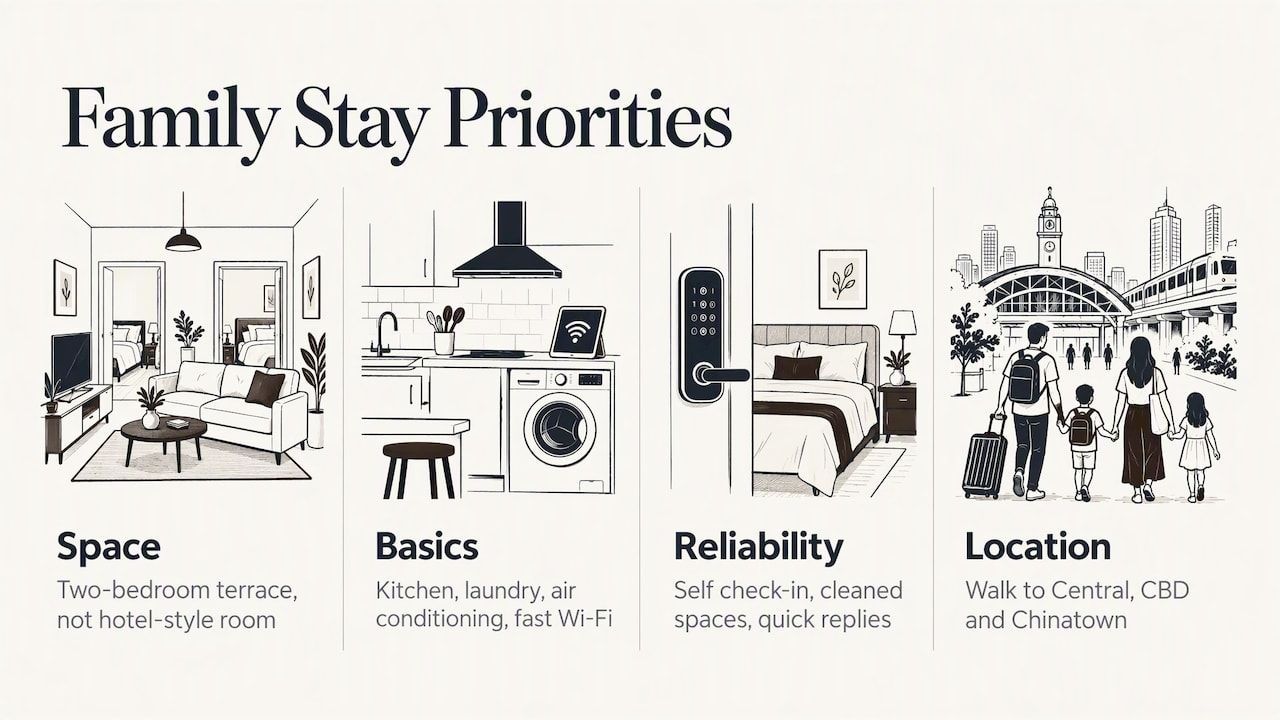
Third, reliability is part of the product. Self check-in, professionally cleaned living spaces and a team that responds quickly to messages mean that when something small goes wrong, you aren't left waiting. Our booking information explains how stays work, and we encourage you to read it, along with our guest reviews, before you commit.
Finally, location is a cost-saver. Staying within walking distance of Central Station, the CBD and Chinatown means fewer taxis, less parking and shorter days out. We would rather you spend that money on the ferry, the zoo or a good dinner.
— User
Our Surry Hills terrace for families
Our featured property is a two-bedroom terrace at 112 Reservoir Street, Surry Hills. It is within walking distance of Central Station, the Sydney CBD and Chinatown, and close to some of the city's best cafés and restaurants. The home has:
- Two comfortable bedrooms
- A fully equipped kitchen
- Air conditioning
- High-speed Wi-Fi and a smart TV
- Laundry facilities
- Self check-in
- Professionally cleaned living spaces
It suits families, couples travelling with another couple, small groups, business travellers and guests who need furnished accommodation for several weeks or months. We offer flexible stay lengths and flexible cancellation, and booking directly on our website gives you competitive rates. You can see the property and its details on the Surry Hills terrace page, browse all short-term accommodation, or read the booking information before you ask us a question.
If you have specific needs, such as a cot, a high chair, step-free access or a particular sleeping arrangement, message us before you book and we will tell you honestly whether the home suits your family.
Accessibility and multi-generational groups
Many family trips include a grandparent, a relative with limited mobility or a child with specific needs. UN Tourism notes that customers with disabilities or specific access requirements, seniors and their families make up up to one third of the global travel market, which is why good hosts publish accessibility details rather than leaving guests to guess.
Ask about:
- The number of steps at the entry and inside the home
- Bathroom layout and whether there is a shower over the bath
- Bedroom location, since an older relative may prefer a room without stairs
- The distance to the nearest station and whether the route is flat
Terrace houses in inner Sydney often have stairs and narrow hallways by design, so ask rather than assume. Multi-generational groups benefit from a layout that allows shared meals and quiet retreats, and Tourism Australia notes that operators serving these groups often offer self-contained layouts that let people share time and still have their own space.
Questions to ask any host before you pay
Copy these into a message. The quality of the answer tells you more than the listing does.
- How many beds are there, and what types? Is any bed a sofa bed?
- Is there air conditioning in the bedrooms?
- Can a portable cot fit in the bedroom, and is one available?
- Where is the laundry, and is detergent provided?
- Are there stairs, balconies or a pool, and what safety features are fitted?
- What are the check-in and check-out arrangements for a late arrival?
- What is the cancellation policy if a child falls ill?
- Who do I contact in an emergency, and how fast do you reply?
A sample day when the base works
Here is how a family of four might use a central, self-contained home on a summer day.
- 7.00 am: Breakfast in your own kitchen, with no queue and no rush.
- 9.00 am: Walk or take the train from Central to the harbour. Lunch is packed from the fridge.
- 1.00 pm: Back at the house in the hottest part of the day. The younger child naps in a closed bedroom while the air conditioning runs, which matches the WHO advice to stay out of the heat at the hottest time.
- 4.00 pm: A walk to a Surry Hills café or park once the temperature drops.
- 7.00 pm: Dinner at home or nearby. A load of washing goes on while the children bathe.
It isn't glamorous, but it is the day most families remember as good.
Planning around events and the neighbourhood
Sydney's calendar is crowded in summer, and big events fill beds across the city. If your dates match a major festival or conference, book before you decide on activities, not after. Our Explore Sydney page is a starting point for ideas near the terrace, from café strips to the harbour.
A central address also helps if you are splitting a stay between sightseeing and school or work commitments, such as a parent working remotely from the Wi-Fi while the children rest.
FAQ
What is the best type of family-friendly accommodation in Sydney?
It depends on your trip, but for most families a self-contained home or apartment with separate bedrooms, a kitchen and laundry is more practical than a hotel room. It gives you space, lets you cook and keeps costs down on longer stays. A family suite in a hotel can work for one or two nights.
Is a two-bedroom terrace suitable for young children?
It can be, but check the details before you book. Ask about stairs, balcony access, hot water temperature and where a cot would fit. At our Surry Hills terrace, message us with your children's ages and we will tell you plainly whether the layout suits them.
When should I book for the Sydney school holidays?
As early as you can. The NSW summer break 2026-27 starts on Friday 18 December 2026 for the eastern division, and Christmas and New Year dates fill first. If your plans are flexible, travelling just outside the break gives you more choice.
Do I need a car if I stay near Central Station?
Usually not. Central connects trains, light rail and buses, and the CBD, Chinatown and the harbour are within reach on foot or by public transport. A car adds parking costs, so many families skip it and hire one only for a day trip.
Sources
- NSW school holidays, NSW Government
- Owning a pool or spa: your obligations, NSW Government
- Heatwaves: how to stay cool, WHO
- Keep cool in the heat and enjoy a sporting summer, WHO Europe
- Burn prevention, WHO
- UN Tourism: practical solutions for accessible and inclusive tourism businesses
- Market Insights: China, Tourism Australia
- How to find a family-friendly apartment, ApartmentAdvisor
Recommended
Recent Posts